
10 Steps to Stabilize Cash, Protect Margins, and Maintain Confidence in Volatile Times

When the economy wobbles, uncertainty spreads faster than facts. Revenue softens. Costs rise. Clients delay payments. For many business owners, that uncertainty triggers panic-driven decisions — cost-cutting, layoffs, or reactive borrowing. But financial uncertainty doesn’t have to equal financial instability.
The key is foresight. A Fractional CFO provides that foresight — transforming chaos into strategy, reaction into readiness, and fear into focus. This playbook outlines 10 essential steps to strengthen your financial resilience and guide your company confidently through volatility.
Step 1: Create a Rolling 13-Week Cash Flow Forecast
Build a weekly cash flow model showing inflows, outflows, and projected balances. Update it every Friday. Integrate data automatically from QuickBooks or Dataverse. Use Power BI to visualize cash position trends and add color-coded alerts for low balance weeks.
Step 2: Model “What If” Scenarios Before They Happen
Develop base, best, downside, and stress test scenarios. Include variables for sales, payroll, and rates. Use Excel or Power BI sliders to instantly see the impact of assumptions.
Step 3: Identify and Categorize Every Cost
Separate fixed, variable, and discretionary costs. Identify costs that scale with revenue and those that don’t. Use Power BI or Excel to simulate cost changes without breaking budget logic.
Step 4: Protect and Prioritize Cash
Accelerate receivables, extend vendor terms, and maintain 8–12 weeks of cash on hand. Automate AR aging reports and set Power Automate alerts for overdue invoices.

Step 5: Strengthen Banking and Investor Relationships
Provide proactive updates to lenders and investors. Share liquidity metrics and debt coverage. Request credit line increases before you need them. Use a one-page Financial Snapshot Dashboard to build trust.
Step 6: Focus on High-Margin Products and Clients
Rank all products or services by margin. Focus resources on the top 30% most profitable opportunities. Use a Power BI Profitability Waterfall to visualize contribution by client or SKU.
Step 7: Implement a KPI Early-Warning System
Track Gross Margin %, AR Aging, Operating Leverage, CCC, and ROIC. Use Power Automate to trigger alerts when KPIs deviate from thresholds.
Step 8: Reforecast Every 30–60 Days
Adopt a rolling forecast model that updates every 30–60 days. Align assumptions with real conditions. Connect Power BI data streams for dynamic forecasting.

Step 9: Align Operations With Financial Strategy
Link budgets to departmental goals and accountability. Use PowerApps to create department scorecards tied to Dataverse for real-time performance tracking.
Step 10: Communicate, Calmly and Often
Hold weekly and monthly update meetings with teams. Share KPIs and progress toward targets. Be factual, forward-looking, and calm. Display dashboards live during updates.
Bonus Step: Invest in Resilience, Not Retraction
Cutting costs alone doesn’t build strength — it only buys time. Use uncertainty to reinforce systems, automate processes, and upskill teams. Prioritize digital transformation projects that improve real-time visibility, reduce manual work, and support forecasting accuracy.
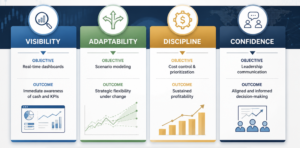
The AWB Associates Framework for Financial Stability
Conclusion: Uncertainty Rewards Preparation
Uncertain markets punish the unprepared but reward those who plan. Implementing these ten steps gives your business control even in unpredictable times. At AWB Associates, financial clarity creates leadership confidence — and confidence fuels growth.
Call to Action
Ready to take control of your financial future? Schedule an AWB Economic Resilience Consultation to assess your current cash position, forecasting tools, and KPI systems. Or download our CFO Readiness Assessment to benchmark your organization’s ability to thrive under uncertainty.